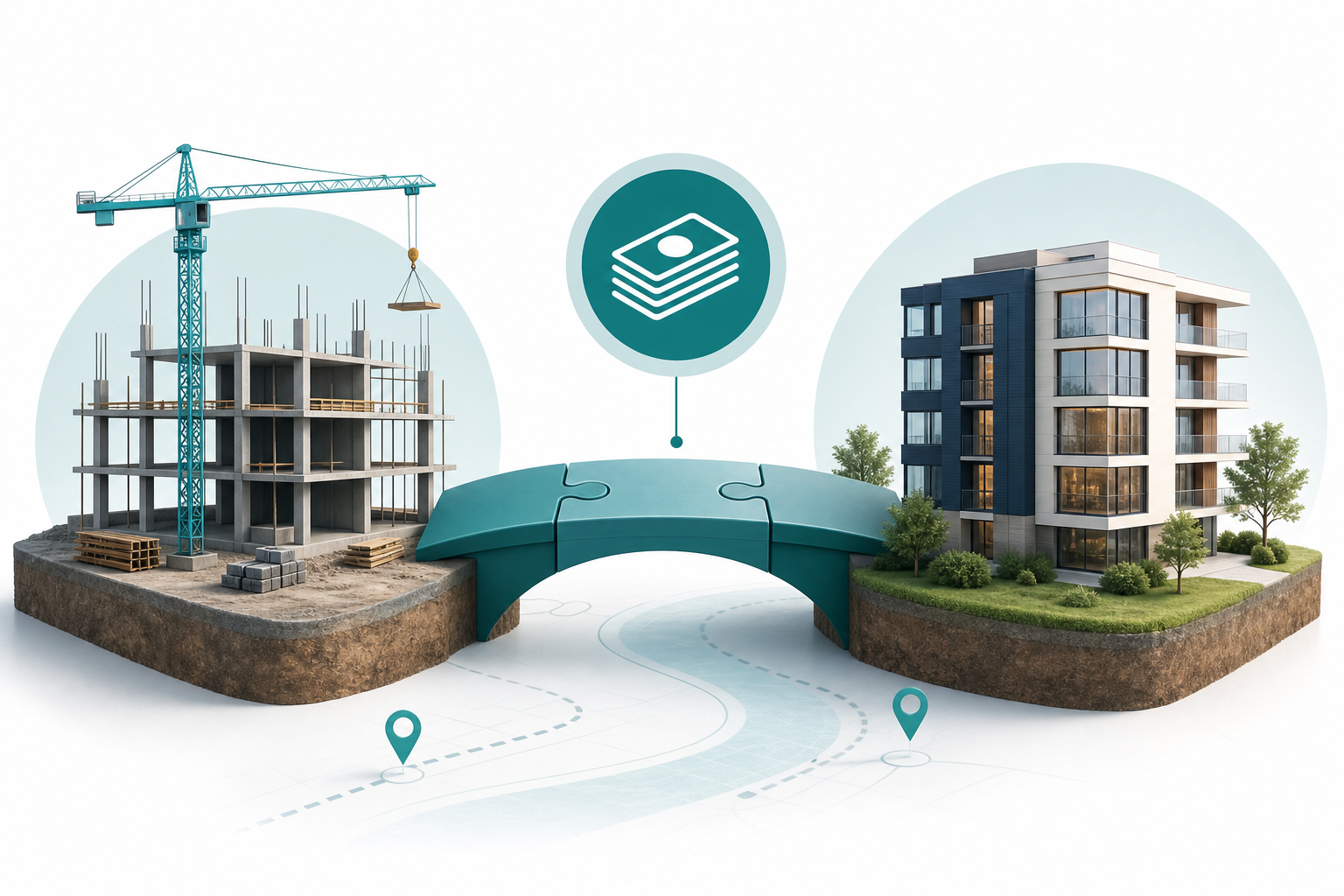
Timing is everything in construction lending, and the gap between when you need capital and when permanent financing becomes available can kill a deal.
A construction bridge loan fills that gap — short-term capital designed to carry a project through the build or heavy renovation phase until a refinance, sale, or stabilized financing closes. Knowing when it fits your deal, how lenders underwrite it, and how to find a counterparty you can trust are the three things this guide covers.
What a construction bridge loan actually is
The name tells most of the story. It is a bridge loan secured by a property that is either under construction or undergoing substantial renovation. The "construction" qualifier matters because it changes how the loan is structured, how draws work, and how lenders assess risk.
Unlike a bridge loan on a stabilized asset, a construction bridge loan is underwritten against a moving target. The collateral is not yet worth what it will be. The lender is betting on completion, and you are drawing funds in stages rather than receiving a lump sum at close.
Most construction bridge loans are structured with an initial advance at closing, followed by draws tied to verified milestones. The lender or a third-party inspector confirms work completion before releasing each draw. This protects the lender and, if you are working with a competent shop, keeps your project on a disciplined schedule.
When this structure makes sense
You are building on land you already own
If you own a lot and need to construct before placing permanent debt, a construction bridge loan is typically the most direct path. Conventional construction loans exist, but they move slowly, require more documentation, and often will not work for investors who need to close fast or hold title in an entity structure.
A private construction bridge loan can close in days rather than weeks. You draw funds as work progresses, pay interest only on what you have drawn, and refinance into a DSCR loan or sell once the project is complete.
You are doing a heavy rehab that exceeds a standard fix-and-flip loan
Standard fix-and-flip lenders underwrite to ARV and fund rehab through draws, but most have limits on structural work, gut renovations, or projects requiring permits and extended timelines. When your renovation scope crosses into ground-up territory — or when the timeline runs past 12 months — you often need a lender specifically built for construction-phase risk.
Construction bridge lenders expect longer timelines, larger contingency budgets, and more involved draw processes. That complexity is their normal.
You need to bridge from construction completion to permanent financing
Some borrowers use construction bridge capital not to fund the build itself, but to cover the period between certificate of occupancy and when a permanent loan can close. Lease-up takes time. DSCR lenders want seasoned rent rolls. That gap can run three to nine months, and a bridge loan keeps you from selling under pressure or missing a refinance window.
Your project does not fit a clean template
Mixed-use buildings, adaptive reuse projects, and infill development in secondary markets often fall outside what agency or bank construction financing will touch. The deal is real, the numbers work, but the collateral type or market size disqualifies it. Private construction bridge capital exists precisely for these situations.
How lenders underwrite construction bridge loans
The ARV anchor
Everything starts with after-repair value. The lender is not underwriting to what the property is worth today — it is underwriting to what the completed project will appraise for, and lending a percentage of that number. Most private construction bridge lenders will go to 65 to 75 percent of ARV, though that range shifts with market conditions, borrower experience, and project type.
Before you submit a package, have a credible ARV supported by comps. Lenders will order their own appraisal or broker price opinion, but if your numbers are far from theirs, the deal stalls.
Borrower experience carries real weight
A first-time builder asking for a $2 million construction loan on a ground-up project is a different risk profile than a developer with 15 completed builds. Most construction bridge lenders tier their terms by experience. Expect higher rates, lower LTVs, and more conservative draw schedules if you are early in your track record.
If you are newer to construction, pairing with an experienced general contractor who has documented project history can partially offset that risk in the lender's eyes.
Reserves and contingency budgets
Lenders want to see that you have enough liquidity to cover cost overruns and carry the loan if a draw is delayed. A 10 to 15 percent contingency built into the construction budget is standard. Some lenders will hold a portion of that contingency in reserve at closing and release it only if needed.
Going in without adequate reserves is one of the fastest ways to lose a lender's confidence before the deal even closes.
What to watch for in the draw process
Construction draws are where a lot of deals get into trouble. The mechanics look straightforward on paper: work gets done, you request a draw, an inspector verifies completion, funds are released. In practice, inspection delays, disputes over percentage of completion, and slow-moving lenders can stall your project and strain your contractor relationships.
Before you close, get clarity on the following:
- Draw request timeline: How many days from request to funding? Some lenders commit to three to five business days. Others are vague.
- Inspection process: Who orders the inspection? Who pays for it? Is the inspector a third party or in-house?
- Draw frequency: Are there limits on how often you can request draws in a given period?
- Retainage: Does the lender hold back a percentage of each draw until project completion?
These details do not show up in the term sheet headline. You have to ask, and how clearly a lender answers tells you something about how they actually operate.
How to find a verified construction bridge lender
This is where counterparty risk becomes real. Construction bridge lending is a specialized niche within private lending. Not every hard money shop has the infrastructure to manage a draw process, and not every lender who says they do construction loans has actually closed many.
The risk of working with the wrong lender is not just a bad rate. It is a lender who slow-walks draws while your contractor walks off the job. A lender who gets cold feet mid-project and stops funding. A lender who disappears when you need an extension.
Vetting matters more in construction lending than in almost any other loan type.
What to look for in a construction bridge lender
- Documented construction loan volume: Ask how many construction loans they have closed in the past 12 months. A lender doing two or three a year is not the same as one doing twenty.
- References from borrowers on completed construction deals: Not general references — you want to talk to someone who went through the full draw process with this lender.
- In-house draw management or a clearly defined third-party process: Ambiguity here is a red flag.
- Clarity on extension terms: Construction timelines slip. A lender who has never thought through their extension policy is not set up for construction lending.
Using a verified directory to vet lenders before you submit a package
Deals move fast, and you rarely have time to vet a new lender from scratch on a live deal. Building a short list of verified construction lenders before you need them is the professional approach.
LenderLedger is a verified professional directory for the private lending industry. You can search lender profiles, read real reviews from borrowers and brokers, and see who has a documented track record in construction lending specifically. No account required to search. The reviews are the signal, not the marketing copy.
If you are a lender or broker active in construction deals, claiming your profile on LenderLedger lets you build a documented reputation across transactions — which matters when a borrower is deciding whether to trust you with a 12-month construction project.
Geographic considerations
Construction bridge lending is not uniform across markets. Lenders active in dense coastal markets may have no appetite for ground-up construction in secondary Midwest markets. Lenders who specialize in single-family new construction may have no experience with mixed-use or multifamily.
When you are searching for a construction bridge lender, filter by market familiarity, not just loan type. A lender who has closed construction deals in your specific market understands local permitting timelines, contractor ecosystems, and realistic ARVs. One who has not is underwriting blind.
FAQs
What is the typical term length for a construction bridge loan?
Most construction bridge loans run 12 to 24 months. Ground-up construction on larger projects may require 18 to 24 months. Shorter-term rehab projects often close with 12-month terms and extension options if the timeline slips.
How are interest rates structured on construction bridge loans?
Most are interest-only loans, meaning you pay interest on the outstanding balance rather than on the full loan amount. Because draws are released in stages, your actual monthly interest cost starts low and increases as more of the construction budget is drawn. Rates vary by lender, market, and borrower profile.
What loan-to-value ratios should I expect?
Most private construction bridge lenders underwrite to 65 to 75 percent of ARV. Some will go higher for experienced borrowers on lower-risk projects. The LTV is based on the completed value, not the current as-is value.
Can I use a construction bridge loan for a ground-up build on land I already own?
Yes. This is one of the most common use cases. The land typically counts toward the borrower's equity in the deal, and the lender advances construction funds through the draw process as work progresses.
What happens if my project runs over the loan term?
Most construction bridge lenders offer extension options, usually for a fee and sometimes tied to project completion milestones. Confirm the extension policy before closing. A lender who cannot articulate their extension terms clearly is not well-suited for construction lending.
How is a construction bridge loan different from a standard fix-and-flip loan?
A fix-and-flip loan is designed for cosmetic to moderate renovations on existing structures, with shorter timelines and simpler draw processes. A construction bridge loan is built for heavier scope, longer timelines, structural work, or ground-up construction. The underwriting, draw management, and lender expertise required are meaningfully different.
How do I verify that a lender has real construction lending experience?
Ask for references from completed construction deals, not just closed loans. Ask how many construction loans they have funded in the past year. Check their profile on a verified directory like LenderLedger to see reviews from actual borrowers who have been through the draw process with them.
A construction bridge loan is the right tool when the timeline, scope, or structure of your project puts it outside what conventional or standard fix-and-flip financing can handle. The loan structure itself is not complicated. Finding a lender who can actually execute the draw process without friction — that is the harder part. Do that work before you have a live deal on the table.